
Cherokee County 24-Hour Release Reality
The official Cherokee County Detention Center page identifies CCDC as a trust under a County Jail Board. It does not expose a verified list of people released today. The required source review also found no official rolling window, field list, update schedule, retention promise, or released-person photo display as of July 31, 2026. That absence is the central fact for a Cherokee County 24-hour release check. A current-custody page cannot be relabeled as a release list, and a person’s disappearance from a roster cannot be treated as proof that the person returned to the community.
The official sheriff page explains why requests must be routed with care. Sheriff Jason Chennault does not operate CCDC or supervise its day-to-day work. The jail is a separate trust-authority department, while the sheriff performs law-enforcement, court-security, transport, and process duties. CCDC or the trust custodian is therefore the starting point for the jail-register entry and discharge transaction. The sheriff may hold a separate arrest or transport record.
The manifest capture of the official CCDC source shows the sparse trust-governance page that was available during review.
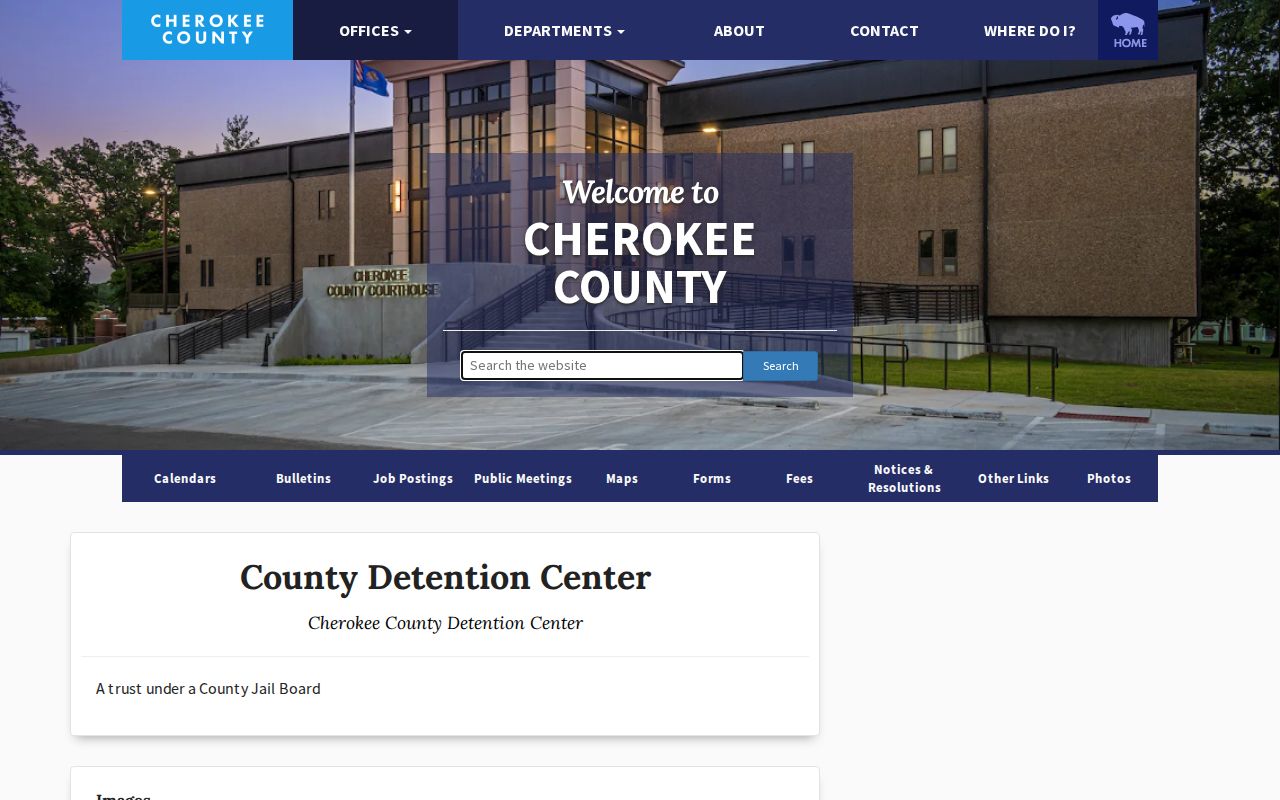
Its lack of a release control or dated feed is why a same-day Cherokee County release must be established through existing records.
Check Cherokee County 24-Hour Releases
Begin with the booking episode, not a broad name search. Write down the full name, date of birth or approximate age, booking number if known, arresting agency, and approximate booking date. Those points help the custodian distinguish two people with similar names and separate repeat bookings. A single person can have more than one valid release date because each booking produces its own custody episode.
- Open the official CCDC page and confirm that the source is Cherokee County, Oklahoma, in Tahlequah.
- Ask the CCDC or trust records custodian for the existing jail-register and discharge entry for the named booking.
- Request the date and time of discharge, manner of discharge, and receiving agency or destination if the entry says transfer.
- Compare the discharge basis with the filed case through OSCN or the Cherokee County Court Clerk.
- If the person entered state custody, check the ODOC Offender Lookup by name and preferably ODOC number.
For one known person, the full Cherokee County released-inmate search path also covers VINELink, court, state, federal, and immigration sources. Those routes should not be run as though each holds the same records. ODOC is not an archive for everyone who left CCDC. A person who posted bond, finished a local misdemeanor term, or had a case dismissed without entering state custody may not appear there.
Note: Record the source and check time because a same-day status can change while agencies complete discharge or transfer entries.
Cherokee County Release Fields to Request
There is no published Cherokee County 24-hour feed with verified display fields. The useful substitute is a narrow request for the existing CCDC jail-register and booking-discharge data. Oklahoma law is unusually direct about part of that record. 51 O.S. § 24A.8 provides access, if kept, to jail-register facts that include the prisoner’s name, commitment details, description, and date or manner of discharge or escape. It does not promise every desired field or require staff to create a custom report.
| Requested field | What it can establish |
|---|---|
| Full name and booking number | The person and exact Cherokee County booking episode. |
| Commitment date and time | When CCDC accepted custody for that episode. |
| Committing authority and recorded cause | Which agency or court placed the person in custody and the stated basis. |
| Discharge date and time | When CCDC custody ended, if a timestamp is kept and disclosable. |
| Manner or reason of discharge | Whether the entry reflects bond, court order, time served, transfer, or another recorded outcome. |
| Receiving agency or destination | Whether the person moved to ODOC, another jail, USMS, ICE, or another custodian. |
Ask for a field legend when CCDC uses a short code. Do not turn an abbreviation into a legal conclusion. “Bond” means the person left that booking subject to the case and bond terms. It does not mean the charge ended. “Time served” addresses the custodial part ordered in that matter but does not by itself end fines, supervision, or another case. “Transfer” is not community release, so the receiving authority matters.
Cherokee County Same-Day Record Request
The county supplies an open-records request form, but that form belongs to the County Clerk and does not make the clerk custodian of CCDC’s operational records. Address the request to the detention center or trust custodian. Ask the recipient to identify or route you to the right custodian if needed. No verified CCDC fee schedule or universal response deadline was found, so request an estimate before charges arise and do not promise a same-day reply.
Under the Oklahoma Open Records Act, I request inspection or an electronic copy of the existing jail-register and booking/discharge fields for the named person and supplied date of birth or booking number, booked about the stated date. Please include the date and manner of discharge, and the receiving agency or destination if the record shows a transfer. If you are not the custodian, please identify the proper custodian and provide a fee estimate before incurring charges.
This wording asks for records that may already exist. It does not ask staff to investigate, answer a questionnaire, or generate a new daily list. Keep the sent request, submission time, recipient, tracking number, estimate, and response. If a record is denied, ask for the legal basis and whether nonexempt parts can be produced. Medical, juvenile, sealed, victim, and security-sensitive details may be restricted.
Cherokee County Release Lag and Proof
Even where a jail offers an online roster, the visible page is a convenience layer rather than the legal discharge record. A removal might occur at the instant of discharge, on the next data update, or after a local retention step. Cherokee County has not published a verified cadence for such a release view. A new status in VINELink may also reflect a participating agency’s update rather than CCDC’s own legal record. The time shown by each source must be read in context.
Use the jail record for the physical exit from CCDC. Use the court docket and filed order for the legal basis. Use the receiving agency for later custody. If ODOC accepted the person on a state judgment, its offender record may show a new facility or status. A federal writ may move the person into U.S. Marshals custody, where there is no broad public locator like the BOP tool. An immigration hold may lead to ICE custody. These are all reasons that someone may vanish from a local roster without being free.
Note: A court disposition date and the moment CCDC completes physical discharge may differ, even when both records are accurate.
Validate Cherokee County Release Sources
Cherokee County release searches have a distinct local hazard: polished results from same-named counties in Alabama, Georgia, Kansas, South Carolina, and Texas can outrank the sparse Oklahoma government page. A page headed “Cherokee County jail releases” is not enough. Confirm the state, Tahlequah location, official county domain, and trust-operated CCDC before using a record. Telephone area codes, agency names, and facility operators can also expose the wrong jurisdiction.
This check matters most in a 24-hour window because a fresh result can look convincing while offering little time for context. The Oklahoma CCDC page states that the jail is a County Jail Board trust. The sheriff page states that the sheriff does not run it. A source that describes CCDC as an ordinary sheriff-operated jail should be treated with caution. The historic Cherokee National Prison in Tahlequah is now a museum and is not a current custody or release-record source.
Cherokee County Release Apps Need Proof
No official Cherokee County, Oklahoma, sheriff or CCDC mobile app advertising recent releases was verified in the source sweep. An app-store listing or vendor page that uses the county name is not enough. Before installing or relying on an app, find an endorsement or publisher link on the official Oklahoma county or CCDC page, then confirm that the feature concerns released people rather than only current detainees, alerts, tips, or another state’s jail.
VINELink is a separate notification layer. It can help with a specific-person status check when the contributing agency participates, but it is not a Cherokee County 24-hour release list and does not create the legal discharge record. Match the source agency, name, identifiers, status phrase, and update time. If no result appears, check spelling and agency scope, then contact CCDC. Nonappearance can reflect timing, participation, suppression, transfer, or a record outside VINELink’s coverage.
Note: Require an official Oklahoma county endorsement before trusting any app that uses the broad name “Cherokee County.”
Cherokee County Release Destinations
A 24-hour inquiry is complete only when it identifies what happened after CCDC custody ended. Community release can follow bond, recognizance, dismissal, time served, or completion of a local sentence. Transfer is different. A felony commitment may send the person to ODOC. Another warrant may produce a move to a different jail. A federal writ may place the person with USMS, while an ICE detainer can result in immigration custody. The discharge manner and receiving agency separate these outcomes.
- Discharge
- The recorded end of one agency’s custody episode.
- Transfer
- A move from CCDC to another custodian without community release.
- Bond release
- Exit from the booking while the court case and bond conditions continue.
- Time served
- Completion or credit of the custodial portion ordered in that matter.
A still-confined person belongs on the live record of the current custodian. A person released from CCDC belongs in CCDC’s discharge record even after a live roster drops the name. A state prisoner belongs in ODOC’s system. Federal sentenced custody belongs in BOP, while federal pretrial custody often requires the case and USMS channel. For a wider date range that may catch several release days, use the Cherokee County 72-hour release process.