
Cherokee County Sheriff Records
The Cherokee County Sheriff’s Office patrols unincorporated areas, investigates crime, provides courthouse security, transports prisoners, and serves district-court civil process. Those duties can create arrest reports, incident records, transport logs, returns of service, or other sheriff records. They do not make the office custodian of all records at Cherokee County Detention Center.
The official sheriff page expressly says the sheriff does not operate the county jail. CCDC is a trust-authority jail and a separate department within county government. The sheriff sits on its overseeing board but has no day-to-day supervisory duty. That statement controls the local records route.
| Question | Likely source |
|---|---|
| What did a deputy do during arrest? | Cherokee County Sheriff’s Office |
| Was the person booked at CCDC? | CCDC jail register |
| When and how did CCDC custody end? | CCDC or trust records custodian |
| What court order authorized release? | Cherokee County Court Clerk |
| Where did a transfer go? | CCDC discharge entry and receiving agency |
Confirm Cherokee County Sheriff Releases
A sheriff record may show that deputies released a person on a citation, moved the person to CCDC, transported the person from CCDC, or delivered the person elsewhere. Each is different. First identify the event. Then obtain the jail or court record that answers the physical custody question.
- Match the full name with a birth date, event date, case, or report number.
- Ask the sheriff for the arrest, incident, or transport record it created.
- If CCDC accepted the person, ask the detention-center trust for the booking and discharge fields.
- Read the court docket and filed order for bond, dismissal, sentence, warrant, or transfer authority.
- When a receiving agency is listed, confirm status with that agency instead of assuming community release.
The full Cherokee County released inmate path explains which state, court, tribal, and federal systems can follow a local event.
Cherokee County Sheriff Contact
The official county page publishes direct office contact information. These details are suited to sheriff-created records and functions. They are not automatically CCDC records contacts. State the event, approximate date, and type of sheriff record sought so staff can route the request.
Cherokee County Sheriff’s Office
912 South College Avenue
Tahlequah, OK 74464
918-456-2583
Fax: 918-458-6594
Email: jchennault@cherokeecoso.org
Hours: 8:00 a.m. to 4:30 p.m., open at noon
These contacts were verified in the July 31, 2026 research and should be checked again before a visit or request. If the record sought is the CCDC discharge date or manner, ask the sheriff to identify the current detention-center trust contact rather than treating the sheriff as the jail custodian.
Sheriff and CCDC Release Roles
Cherokee County differs from the common Oklahoma assumption that a sheriff runs the local jail. CCDC’s trust structure divides responsibility. The sheriff can create the first and last transport records around a jail stay, while CCDC creates the custody episode between those events. The court creates the legal order.
The captured official Cherokee County Sheriff page shows the governance distinction that changes where a release-record request belongs.
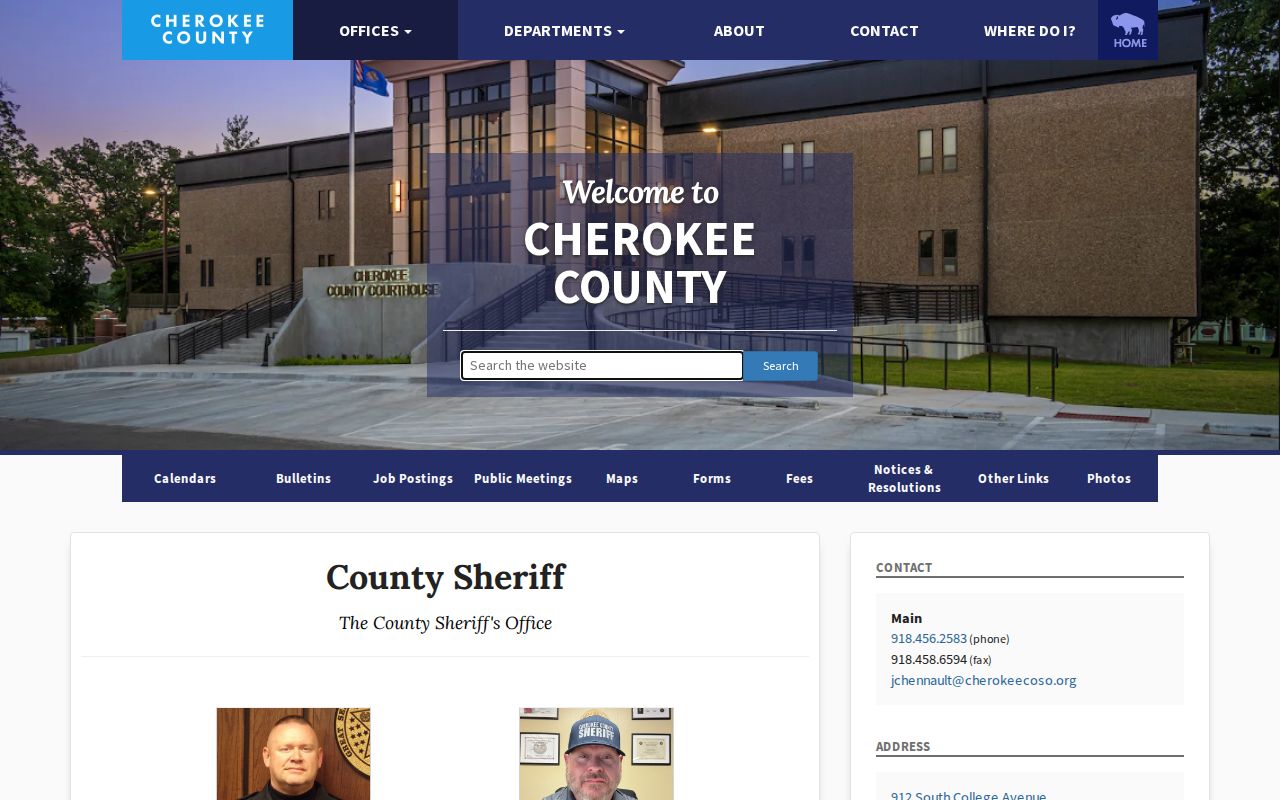
The image supports the division of roles, not a claim about any named person. Always match the requested record to the agency that made it.
Q: Can the sheriff confirm a CCDC release? The office may know about a transport or its own arrest record. The CCDC trust’s jail register is the direct source for the jail’s discharge entry.
Request Sheriff Arrest Records
A request should be narrow and factual. Give the person’s full name, the event date or range, the place if known, and a report, incident, warrant, or case number. Ask for inspection or an electronic copy of the existing record. Do not ask staff to make a new narrative or calculate a release date.
For a CCDC booking tied to a sheriff arrest, two requests may be needed. The sheriff record can explain the arrest or transport. The CCDC record can supply the commitment and discharge fields. The court record can establish the order or disposition. Compare dates and agency labels before joining the records.
A correction should also go to the office that controls the source record. If a sheriff report has the wrong identifying detail, ask the sheriff about its correction process. If the CCDC discharge code is wrong, contact the trust custodian. An online court summary should be checked against the filed document. Changing one record does not silently change each related system.
Oklahoma’s 51 O.S. § 24A.8 addresses specified law-enforcement and jail-register material, including date or manner of discharge if the jail-register information is kept. Exempt material can still require redaction or withholding. Ask for nonexempt portions and the stated legal basis if access is denied.
Note: No local source established one flat charge or response time for every sheriff or CCDC record, so request an estimate.
Cherokee County Release Jurisdiction
Tahlequah is also the center of Cherokee Nation government. An arrest connected with Indian country may involve city, county, tribal, state, or federal actors based on the facts and law. The right sequence is to identify the arresting sovereign, filing court, facility that accepted custody, and agency that received the person next.
The Cherokee Nation Marshal Service uses tribal law and agency rules. Its restricted criminal-justice request form is not a general public Oklahoma Open Records Act form. Tahlequah Police records may document a municipal arrest or citation release. USMS records may explain a federal writ. None of those sources should be folded into a sheriff record merely because the event happened in Cherokee County.
Search results for other Cherokee Counties pose another risk. Check Oklahoma, Tahlequah, the 918 area code, and the official county domain. A polished Alabama, Georgia, Kansas, South Carolina, or Texas roster cannot answer a Cherokee County, Oklahoma release question.
Sheriff ICE Transfer Records
The sheriff may create a transport record connected with an immigration detainer, while CCDC records the jail exit and ICE records later custody. ICE describes a detainer as a request for notice and a short added period so DHS can assume custody. A record of delivery to ICE is a transfer, not release to the community.
The research found no proof that CCDC presently holds a specific ICE contract or that any named person has a detainer. Use this path only when the actual booking, transport, court record, or counsel supports it. When relevant, pair the sheriff transport record with the CCDC discharge notation and the official ICE locator. Locator lag or nonappearance is not proof that custody ended.
Sheriff Release Record Limits
The sheriff page is not a live CCDC roster or recent-release list. As of July 31, 2026, no verified official CCDC rolling 24-hour or 72-hour feed and no endorsed release app was located. Do not use a current-custody page as a released-person report, and do not infer a release from a missing name.
Use a sheriff record for the event it describes. Use the CCDC jail register for the jail episode. Use the court order for the legal action, and use ODOC, BOP, ICE, USMS, or another jail for later custody. That source-by-source method is slower than one name search, but it preserves the difference between a true community release and a transfer.
VINELink can add a status or notification from a participating source, but it does not create the sheriff’s record or CCDC’s legal discharge entry. Match the source agency and last update. A result tied to ODOC concerns state custody or supervision, while a CCDC-sourced result concerns that local booking. Never merge them because the names match.
For a sentenced state case, read every ODOC sentence row and compare the Cherokee County case number. The county shown in a sentence row identifies the sentencing county, not a current place of confinement. A state institution or reception status can show that the person left local custody by transfer. A probation or parole entry may show community supervision after incarceration, but only in the context of its dates and sentence.
For a federal matter, BOP is mainly the federal prison route and can retain historical release results. USMS often handles pretrial detention and transport and has no matching broad public locator. A BOP “not found” result cannot resolve a sheriff arrest, a CCDC booking, or a person held for federal court by another custodian.
Verified as of July 31, 2026. Recheck official contacts and dynamic custody sources when making a current inquiry.